OUR LIVING AND VIRTUAL LABS
FIN operates from three locations in India and one online community (FIN Centre for Circular Economy).
- Two Rural Living Labs: FIN Kameswaram, founded in 2006, is our rural living lab in Kameswaram village (Tamil Nadu, India)
- A new centre FIN Vizundamavady was founded in the neighbouring village of Vizundamavady in 2025.
Both these rural living labs seeks to motivate, support, facilitate, monitor and evaluate the introduction of innovations in the form of new structures, new technology, new management routines and new social norms, to attain environmental and socio-economic security in the marginalized zones of India. Their activities include design innovations for climate resilient WASHE infrastructure along with initiatives for sustainability education, livelihood creation through production and sales of eco-friendly products and community engagement appropriate for rural India.
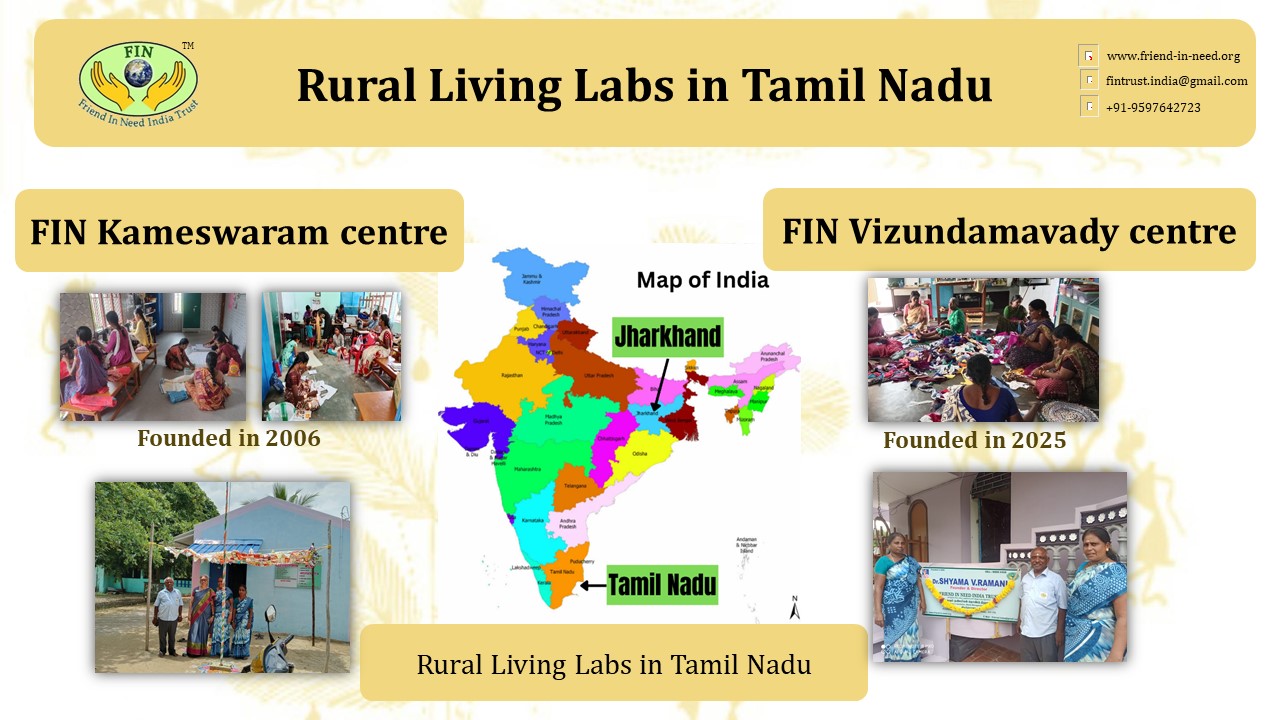
- FIN Jharkhand Division was founded in 2023 and is located in Ramgarh Cantonment, Jharkhand. Our Junior manager Abhishek Pathak implements FIN projects in Jharkhand and organises events to promote safe sanitation and waste management, while supporting FIN activities over all. It also focusses on education, public toilets and waste management systems in public places.
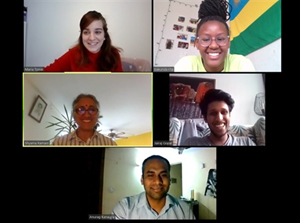
- A Virtual Lab: Centre for Circular Economy, our virtual lab of academics, professionals and students passionate about contributing to a cleaner and greener India and world through teaching, training and research. The Centre for Circular Economy is the Teaching, Training and Research activities hub of Friend In Need India Trust. The Centre organizes and hosts online and onsite workshops to bring together key stakeholders and change makers and provides opportunities for interaction with them. These workshops also incorporate site visits as an important component in order to provide first hand experience to the challenges in the field.
All our centres aim to facilitate India’s transition circular economy. Until recently, economic growth policies largely followed a linear economy model, treating waste as an unavoidable negative externality of production and consumption. Globally, this perspective is now shifting towards a circular economy that minimises waste while sustaining economic growth. Designed to be regenerative, the circular economy emphasises longer product use, reuse, refurbishment, remanufacturing, and recycling, with minimal non-recyclable waste.