
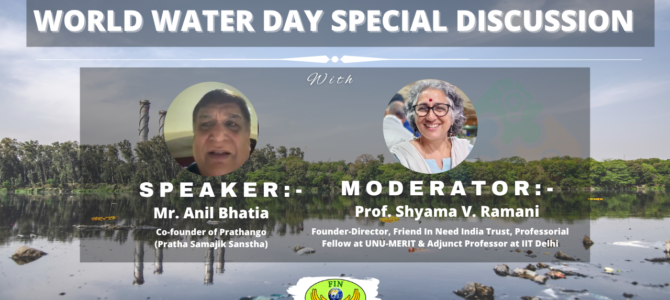
At FIN, we have long marked World Water Day with webinars designed for learning. This year, I am sharing something I hope goes further: a recorded interview with Anil Bhatia, one of India’s most compelling sanitation entrepreneurs and the mind behind the Suvidha community toilet model. It can be a teaching resource.
I am inviting educators in social work, business, and economic development to use this interview in your classrooms. Whether you teach at a university or a training institute, this interview can anchor a case study, spark a seminar discussion, or serve as the foundation for a business plan exercise.
Our sincere thanks to Anil, who shares his personal journey and provides candid answers about how he built a financially sustainable sanitation service that serves some of the most underserved communities in India.

Each question in the interview is paired with a student reflection prompt — covering entrepreneurship theory, business models for the poor, labour markets, community participation, gender, public-private partnerships, and social infrastructure, as given below.
1. Who are you? What is your background? How did you come to be a sanitation entrepreneur?
– For students: how does this narrative correspond to the different stages of entrepreneurship? What characteristics of an entrepreneur does Mr Anil Bhatia exhibit?
2. For community toilets – the main problem is balancing the financial sustainability of the service with ensuring accessibility to the poor, as they cannot always pay. How did you tackle this?
– For students: how does this narrative correspond to the business models given in the literature on financial sustainability in markets for the poor?
3. How did you address the challenge of finding labour to maintain community toilets, as this work is stigmatised?
– For students: What are the characteristics of any challenging work that make it unpopular? What are the strategies deployed by companies to ensure labour for such jobs?
4. In what ways did the local community participate?
– For students: how does this narrative correspond to the different models of community participation in the success of an enterprise,, both in markets for the poor and mainstream markets?
5. What is the gender profile of your users/staff?
– For students: What insight can you draw from the answer? Can you name other markets that are gendered?
6. Suvidha seems to have been the result of a multi-stakeholder consortium. Can you elaborate on who was involved and the role of each entity?
– For students: Can you identify other models of multi-stakeholder consortia that have created social businesses to serve the poor? What is the role of each stakeholder in the Suvidha enterprise? How does it correspond to other consortia evoked in the literature?
7. What can you say about the governance of community toilets?
– For students: What insight can you infer from public-private partnerships from this example?
8. What are the challenges you faced? What is the future?
– For students: How are social infrastructures different from physical infrastructure? Whose responsibility is it to build/strengthen our social infrastructures? Draw up a business plan for setting up a community toilet in the slum near your institute/home.
