
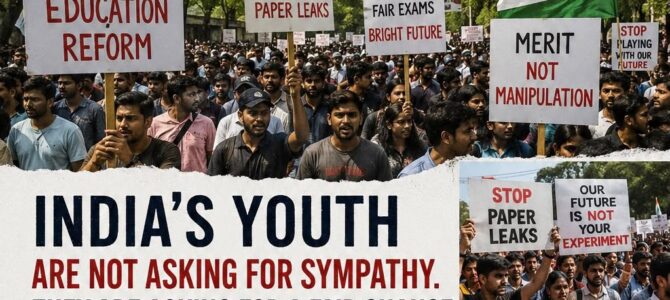
The ongoing demonstrations at Jantar Mantar have once again placed India’s education system under national scrutiny. While the immediate demand of many protestors is linked to accountability and the resignation of the Union Education Minister, the larger question goes far beyond one individual, one government, or one political party.
It is about trust.
India has one of the youngest populations in the world, with nearly 65% of its population below the age of 35 and over 250 million students enrolled across schools and higher education. Every year, millions of young people prepare for competitive examinations that determine their future. NEET attracts nearly 2 million aspirants annually, while examinations such as JEE, CUET, UPSC, SSC, Banking, Railways and various State Public Service Commissions collectively involve tens of millions of candidates every year. For many families, these examinations are not merely tests—they represent years of sacrifice, savings, and hope.
When examination irregularities, paper leaks, delayed results, or allegations of unfair practices surface, the consequences extend far beyond administrative failures. A delayed examination can cost a student an entire academic year. A leaked paper can erase months of honest preparation. For many candidates from rural or economically weaker backgrounds, every additional attempt means extra coaching expenses, travel costs, emotional pressure, and sometimes giving up employment opportunities.
The issue, therefore, is not simply about one examination. It is about protecting the credibility of an education system that shapes the future of the nation.
The protests at Jantar Mantar reflect the frustration of thousands of students who believe the system must become more transparent, accountable, and secure. At the same time, the government has announced investigations, administrative reforms, and stronger measures to address examination-related irregularities. Whether these efforts are sufficient will ultimately depend on their implementation, transparency, and the confidence they restore among students.
As citizens, it is important to remember that democracy functions best when concerns are expressed peacefully, and institutions respond responsibly. Public protests, judicial oversight, administrative action, media scrutiny, and policy reforms all play legitimate roles in strengthening democratic governance. Constructive dialogue—not polarisation—creates lasting solutions.
However, this moment also demands honest self-reflection.
India has made remarkable progress in expanding access to education. Literacy has improved significantly over the decades. The National Education Policy (NEP) 2020 aims to modernise learning, encourage multidisciplinary education, strengthen vocational skills, and improve employability. Digital learning platforms have expanded educational access to remote regions. These achievements deserve recognition.
Yet access alone is not enough.
Young people today are asking difficult but necessary questions:
* Is our examination system truly secure?
* Are recruitment processes transparent?
* Does merit receive the respect it deserves?
* Are students receiving education that prepares them for employment rather than only examinations?
* Is mental health receiving adequate attention in a highly competitive environment?
These are not political questions. They are national questions.
India’s demographic dividend is often described as its greatest strength. But a demographic dividend becomes an economic dividend only when education is credible, skills are relevant, and opportunities are fair. A nation cannot aspire to become a global knowledge economy if students begin to lose faith in the institutions designed to evaluate them.
As a society, we must move beyond reacting only when crises emerge. Education reform should include stronger examination security, greater transparency in recruitment, quicker grievance redressal, independent oversight, responsible use of technology, improved teacher training, mental health support for students, stronger vocational education, and closer alignment between education and industry needs.
Most importantly, the conversation should never become a contest between political ideologies. The future of India’s students is too important to be reduced to partisan debates. Governments may change, ministers may change, policies may evolve—but the aspirations of India’s youth remain constant.
At FIN India Trust, we believe education is not merely about passing examinations or earning degrees. It is about creating equal opportunities, building confidence, developing skills, and enabling every young person to contribute meaningfully to society.
We do not take sides in political debates. We stand with students, educators, parents, and every citizen who believes that India’s education system must be transparent, accountable, inclusive, and future-ready.
Because when millions of young Indians demand a better education system, they are not asking for special treatment.
They are asking for something every democracy owes its youth—fairness, integrity, and hope.